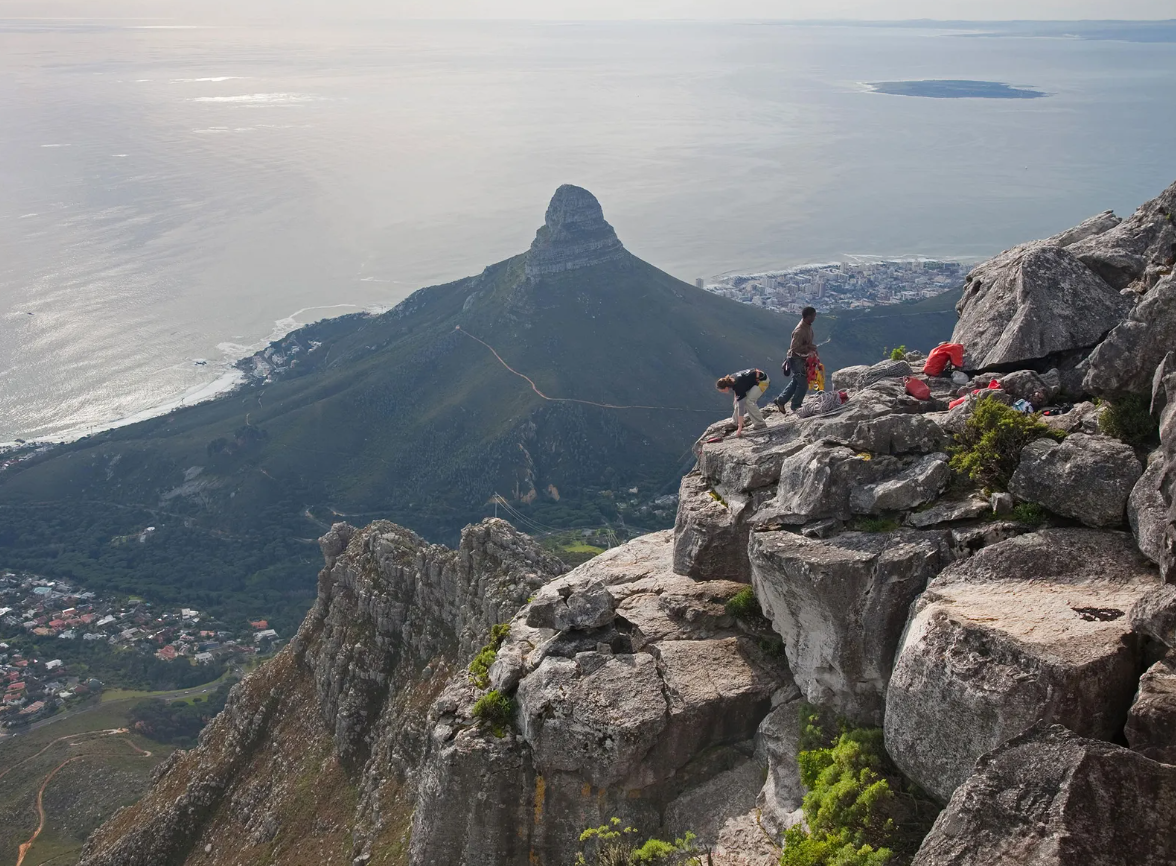
Why visit Table Mountain
Table Mountain is one of the world's oldest mountains and part of the smallest and richest of the six floral kingdoms on Earth. The plateau supports more than 2,000 plant species — many endemic to this mountain and nowhere else.
It's also the best single viewpoint over Cape Town, the City Bowl, Robben Island, the Cape Peninsula and both oceans. Anyone visiting the city should get up there at least once.
Where Table Mountain is
Table Mountain forms the northern edge of Table Mountain National Park, which stretches south from the City Bowl to Cape Point.
The Aerial Cableway lower station is on Tafelberg Road above Kloof Nek, a 10-minute drive from central Cape Town.
What to expect
The Aerial Cableway rotates as it climbs, giving 360° views on the 5-minute ride up. On top there are walking loops, viewpoints, a restaurant and a café.
Hikers can go up via Platteklip Gorge (the most direct route, 2–3 hours), Skeleton Gorge (via Kirstenbosch) or the India Venster route (more technical, guide recommended).
Cloud can form on top quickly — the famous 'tablecloth' — so plan for changing weather even on clear days.
Best time to visit
Early to mid-morning is usually clearest.
October to April for the most reliable weather.
Sunset trips are spectacular but the cableway queue can be long — Wanderer books timed tickets to skip it.
How to include Table Mountain in a Wanderer private tour
Table Mountain is the headline stop on a Wanderer Cape Town City Tour, usually combined with Bo-Kaap, the Company's Garden and the V&A Waterfront.
Because the cableway is weather-dependent we watch the forecast and status page throughout the morning and shift the day's timing to hit the mountain when it's open and the views are clear.
Practical tips
- Book cableway tickets in advance or arrive at opening time.
- Take a warm layer — temperatures on top are typically 5–10°C cooler than sea level.
- Wear proper shoes if you plan to walk the plateau loops.
- Check @tablemountainca on X or the SANParks cableway status page for closures.