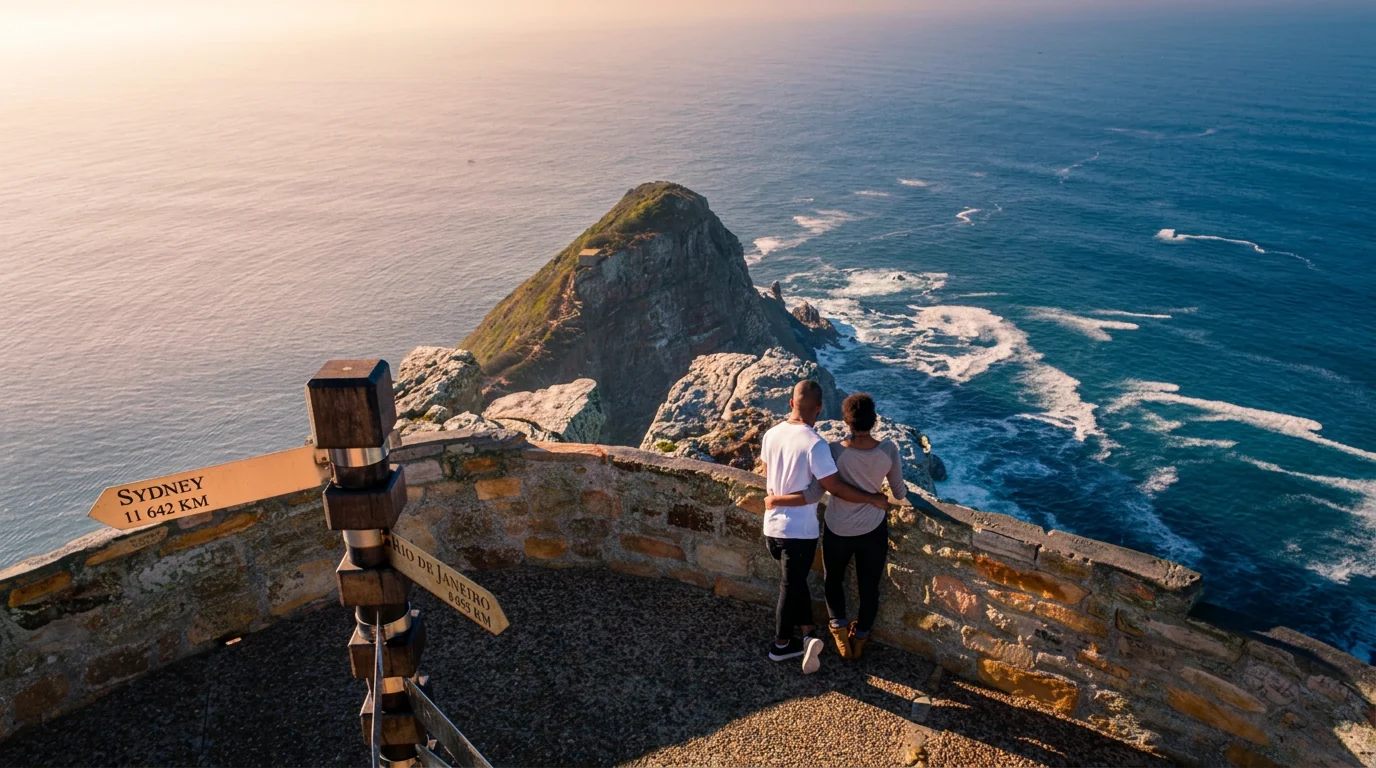
What is the Cape of Good Hope?
The Cape of Good Hope is the south-western headland of Africa — a windswept promontory of Cape granite jutting into the Atlantic. It's not the southernmost point of Africa (that's Cape Agulhas), but it's the historically important one: Portuguese navigator Bartolomeu Dias rounded it in 1488, opening the sea route from Europe to India and permanently changing world trade.
Today the headland sits inside the Cape of Good Hope Nature Reserve, a 7,750-hectare protected area within Table Mountain National Park. The reserve encompasses both the Cape of Good Hope itself and Cape Point, along with kilometres of coastal fynbos, empty beaches, and hiking trails.
Cape of Good Hope vs Cape Point
Visitors often confuse the two. They're both inside the same nature reserve, about a 10-minute drive apart:
Cape of Good Hope — the rocky south-western tip, at sea level. This is where the famous 'Cape of Good Hope' signpost stands, and where you can walk out onto the rocks and beach.
Cape Point — the taller cliff further east, topped by two lighthouses (the Old and New Point lighthouses). The Flying Dutchman funicular carries visitors most of the way up; the last section is a short paved path.
Most private day tours from Cape Town visit both — the Cape of Good Hope sign first, then drive across to Cape Point for the lighthouse walk.
History — why the name?
Dias originally called the cape the 'Cape of Storms' (Cabo das Tormentas) after the weather he encountered rounding it. King John II of Portugal renamed it Cabo da Boa Esperança — Cape of Good Hope — for the hope it gave of a sea route to the East Indies.
For nearly 400 years afterwards, virtually every European ship heading to India, the Spice Islands or East Africa passed within sight of these cliffs. That trade route is the reason Cape Town exists.
The reserve — what to see and do
Inside the Cape of Good Hope Nature Reserve you have: the Cape of Good Hope signpost (the classic photo stop), the Cape Point lighthouse loop, the Diaz Beach viewpoint (a long wooden staircase down to an empty white beach), Buffels Bay picnic area, and multiple short hikes — including the Shipwreck Trail and Antoniesgat.
Wildlife is genuinely part of the experience. Bontebok, eland and Cape mountain zebra graze the fynbos; ostriches wander the roadside; and troops of chacma baboons are a permanent, mischievous presence — never leave food visible in a car and never approach them.
Best time to visit
Cape of Good Hope is a year-round attraction. In summer (Dec–Feb), the light is bright but the wind is strongest. In autumn (Mar–May) the light is softer and the wind eases. Winter (Jun–Aug) can bring dramatic storms and long sunny gaps, plus southern right whales offshore. Spring (Sep–Nov) brings wildflowers to the coastal fynbos.
Timing within the day matters: the reserve opens early and the first two hours are the quietest. By mid-morning the big coaches arrive. Wanderer's private tours typically front-load the reserve so you experience it before the crowds.
How it fits into a Cape Point day
On a private Cape Peninsula day from Cape Town, the reserve is the natural midday anchor. A typical timing: leave Cape Town 07:30–08:00, drive the Atlantic Seaboard and Chapman's Peak, enter the reserve mid-morning, spend 90 minutes to 2 hours covering both headlands, lunch in Simon's Town, then Boulders Beach in the afternoon before the drive back via Kalk Bay.
It's a full but comfortable day — the whole loop is around 200km including all the stops.
Hiking and the trails
For visitors who want more than viewpoints, the Cape of Good Hope Trail is a serious 2-day overnight coastal hike with a hut booking. Shorter options include the Shipwreck Trail (1–2 hours), the Antoniesgat cove walk, and the paved Cape Point lighthouse loop. Wanderer can arrange guided hikes and picnic lunches on request.
Practical tips
- Bring a windproof outer layer — the south-easter can be strong even in high summer.
- Do not feed the baboons and don't leave food or shopping visible in a car — they will break in.
- Cellular coverage is patchy inside the reserve; download offline maps in advance.
- The reserve has one restaurant (Two Oceans, near Cape Point car park) — busy at lunchtime; book ahead or eat in Simon's Town.
- Toilets and taps are at the main car parks, not on the trails.
Responsible travel
- Stay on marked paths — the coastal fynbos is a UNESCO World Heritage biodiversity hotspot.
- Give wildlife space. Zebra, ostrich and baboons look habituated but are wild animals.
- Take all litter home. The strong wind spreads even small pieces across the fynbos.