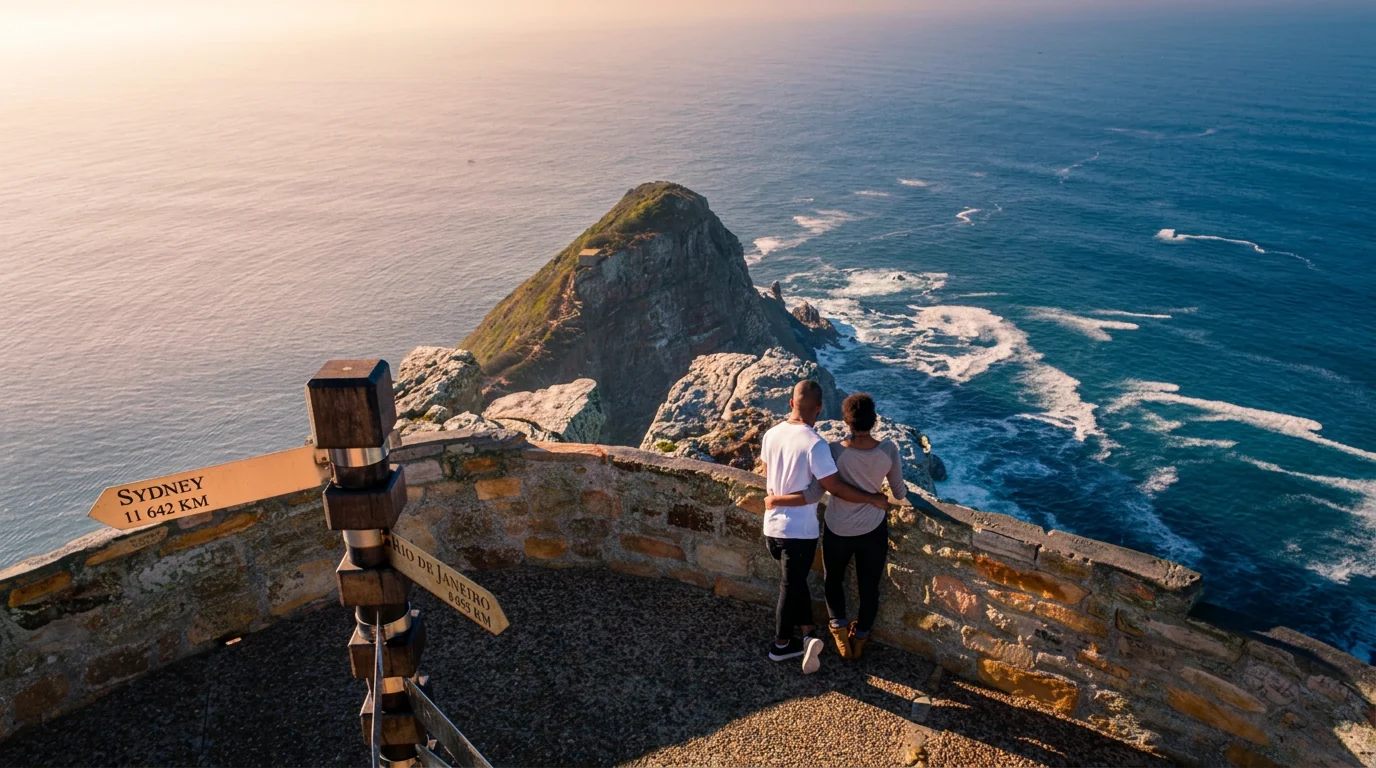
What is Chapman's Peak Drive?
Chapman's Peak Drive is a scenic coastal road along the Atlantic side of Cape Town's peninsula, blasted out of the cliff face over a hundred years ago and re-engineered in the 2000s with modern rockfall canopies. It links Hout Bay in the north to Noordhoek in the south, curving around the flank of Chapman's Peak (593m) with the ocean directly below and near-vertical rock above.
The road is a national heritage engineering site, a working commuter route, and — for visitors — one of the most spectacular short drives on the planet.
Why the drive matters
The geological layering is what makes it so photogenic: the darker Cape Granite base, the horizontal reddish Table Mountain sandstone above, and then a sheer Atlantic drop. There are several signed pull-outs where you can stop, walk to the low walls and look back across Hout Bay to the Sentinel, or south towards Noordhoek's long white beach.
It's also the fastest, most beautiful way to get between the Atlantic Seaboard and the far southern peninsula — no matter how many times you drive it, the view changes with the light and the swell.
Where it fits in a Cape Point day
The classic private Cape Peninsula tour uses Chapman's Peak as the connector between Cape Town's Atlantic side and the deeper southern peninsula. A typical route: Camps Bay → Llandudno viewpoint → Hout Bay (optional Sentinel view or seal cruise) → Chapman's Peak Drive → Noordhoek Beach → Kommetjie → Cape of Good Hope Nature Reserve → Cape Point → Simon's Town → Boulders Beach → back via Kalk Bay.
The drive itself is 20 minutes, but with two or three viewpoint stops it's a comfortable 45–60 minute experience.
Best time to drive Chapman's Peak
Photographically, late afternoon is the winner — the sun comes in from the west and lights the cliffs. Drive it northbound (Noordhoek → Hout Bay) at golden hour for the best light on the rock face.
For traffic, weekday mornings are quietest. Summer afternoons see the strongest wind, and occasional gale-force gusts can close the road briefly. Winter can bring rain-triggered rockfall closures. Our local guides always check status the day before and morning of every tour.
Tolls, closures and safety
There's a modest toll payable at either gate — small vehicle rates are the norm for passenger cars. The toll pays for the ongoing engineering work that keeps the road safe under a very active piece of geology. Rates and closures are posted at chapmanspeakdrive.co.za.
When Chapman's is closed, the alternative is Ou Kaapse Weg — a beautiful high-altitude pass across the middle of the peninsula. Wanderer's private tours automatically re-route with no loss of Cape Point time.
Viewpoints and stops
The two most-photographed pull-outs sit roughly a third and two-thirds of the way along the drive, on the west side. Both have safe parking and a low stone wall. From either you can shoot back across Hout Bay to the Sentinel, or south along the curving cliff line.
Hout Bay itself is worth a stop before or after — the harbour is a working fishing village with fresh seafood, a small craft market, and Duiker Island seal boat trips departing from the pier.
Photography tips
For the classic Chapman's Peak shot — the road curving around a cliff with the Atlantic below — the second viewpoint heading north is the best. A wide-angle lens works, but the road is actually more dramatic slightly compressed with a 35–50mm equivalent.
Sunset from Noordhoek Beach (a few minutes past the southern gate) is one of the best-kept photography secrets in Cape Town — the beach is 8km long, so there's always empty foreground.
Practical tips
- Fill up in Hout Bay or Camps Bay before you start — there's no petrol on the drive itself.
- Take layers: even on a hot day, the pull-outs can be windy and cool.
- If you're self-driving, keep to the speed limit — the corners are sharper than they look.
- Cyclists use the road heavily on weekend mornings — pass patiently.
- There are no barriers between the outside lane and the drop; concentrate on the drive, use the viewpoints for the view.
Responsible travel
- Only stop at signed pull-outs — stopping on the road itself is dangerous and illegal.
- Don't drop anything off the wall — this is a working ecosystem and a busy road below.
- Pack in, pack out. Bins are limited.