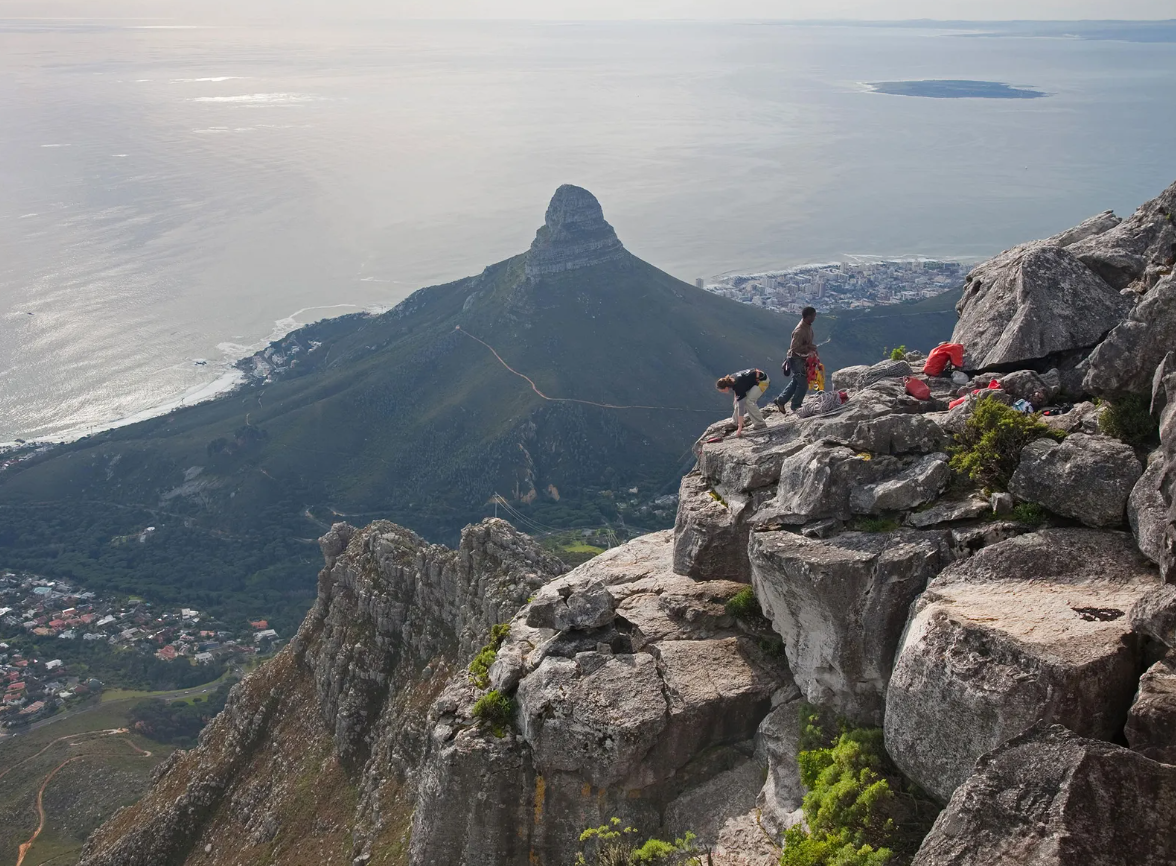
What Table Mountain is
Table Mountain is a flat-topped sandstone plateau, about 3km wide and 1,086 metres above sea level at its highest point, forming a natural amphitheatre around Cape Town's City Bowl. It sits inside Table Mountain National Park, part of the Cape Floral Region — one of the six great floral kingdoms of the planet and a UNESCO World Heritage Site.
Geologically it's one of the oldest mountains in the world — hundreds of millions of years old — and one of the very few places on earth where a mountain of this scale rises straight from the sea at the edge of a major city.
Why it matters
Table Mountain is the reason the modern city exists in this exact location — the flat top of the mountain traps water, and the streams running off the mountain provided the fresh water that persuaded the Dutch East India Company to build a resupply station here in 1652.
It's now one of the New 7 Wonders of Nature and the single most-photographed natural landmark in South Africa. The 'tablecloth' — a rolling cloud that spills over the plateau in a south-easter — is a Cape Town weather signature.
The Cableway
The Table Mountain Aerial Cableway is the fastest way up: a rotating cable car (the floor slowly turns during the ride) that takes about 5 minutes to reach the summit from the lower station on Tafelberg Road. It runs from early morning to sunset, with hours varying by season.
The cableway closes in high winds and for annual maintenance (typically late July / early August). Book online in advance — walk-up queues can be very long in peak season and at sunset. Wanderer includes cableway tickets in our City Tour when the weather is right.
Hiking routes
Three main hiking routes go up from the front (city) side, plus several longer routes from behind:
Platteklip Gorge — the direct, steep, unshaded route straight up the front. About 2.5–3 hours up, moderate to hard. Well-marked; the most popular independent hike. Start early to avoid heat.
Skeleton Gorge — the classic forested route from Kirstenbosch Botanical Garden. Longer, more scenic, requires committing to a longer day. Best with a guide who knows the summit route back to the cableway.
India Venster — a spectacular but technical route with exposed chain sections. Guided only. Do not attempt independently.
For anything other than Platteklip, hire a registered mountain guide. Wanderer can arrange guided hikes at any of the three levels.
On top — what to do
The summit is a series of interconnected paths across the plateau. The main viewpoints (Maclear's Beacon, Upper Cableway Station viewing decks, the Western Table) are all reachable on flat or gently undulating paths. Allow 60–90 minutes on top to walk it properly.
There's a café and small shop at the upper cableway station. Toilets and taps are available. The wind at the summit is often significantly cooler than in the city — take a windproof layer even on hot days.
When to visit
Summer (Dec–Feb) has the longest days and warmest weather but also the strongest south-easter — expect some cableway closures. Autumn (Mar–May) is arguably the best combination of warm days, softer light and calmer winds. Winter (Jun–Aug) is cold and often clear on non-storm days. Spring (Sep–Nov) brings wildflowers to the summit fynbos.
Within any given day, early morning is calmest and clearest; sunset is spectacular but busy. A common tactic: cableway up mid-morning, walk the plateau, cableway down at sunset — but check the wind forecast before committing.
How it fits into a Cape Town itinerary
Because Table Mountain is weather-dependent, the honest advice is: keep a day flexible for it. On a private tour with Wanderer, we watch the forecast and re-schedule to whichever day gives you the best chance of a clear summit.
Half-day (cableway up and back, one hour on top) fits well after a morning Cape Town City Tour. Full-day (guided hike + summit + cableway down + lunch) works as a day of its own. If you want a mountain experience with less weather risk, Lion's Head and Signal Hill are excellent smaller alternatives.
Practical tips
- Book cableway tickets online in advance for peak season and any sunset trip.
- Check the wind and cloud forecast the morning of your visit — under about 20km/h summit wind is a good sign.
- Take a windproof jacket even in summer.
- Wear proper closed shoes — the summit paths are rocky.
- Take water and a snack; the café is small and can be busy.
Responsible travel
- Stick to marked paths — the summit fynbos is a protected botanical hotspot.
- Pack out everything you brought in; there are limited bins on top.
- Do not attempt technical routes (India Venster) or off-piste scrambles without a registered mountain guide.
- Weather can turn in 30 minutes on the mountain. If the cloud closes in, head straight to the cableway.